

Augusta,
with Harold, Per, Julie, & Sean
Harold Ancart, Per Kirkeby, Augusta Lardy Micheli, Julie Mehretu, Sean Scully
Curated by Emma Loy
September 10 - October 3, 2026
Opening reception: Thursday, September 10th, 6 - 8 pm
As indicated by its title, this exhibition brings together a new suite of Augusta Lardy’s paintings alongside selections from Harold Ancart, Per Kirkeby, Julie Mehretu, and Sean Scully. While each artist charts a different course, shared thoroughfares exist in natural abstraction, perspectival shifts, and material inquiry.
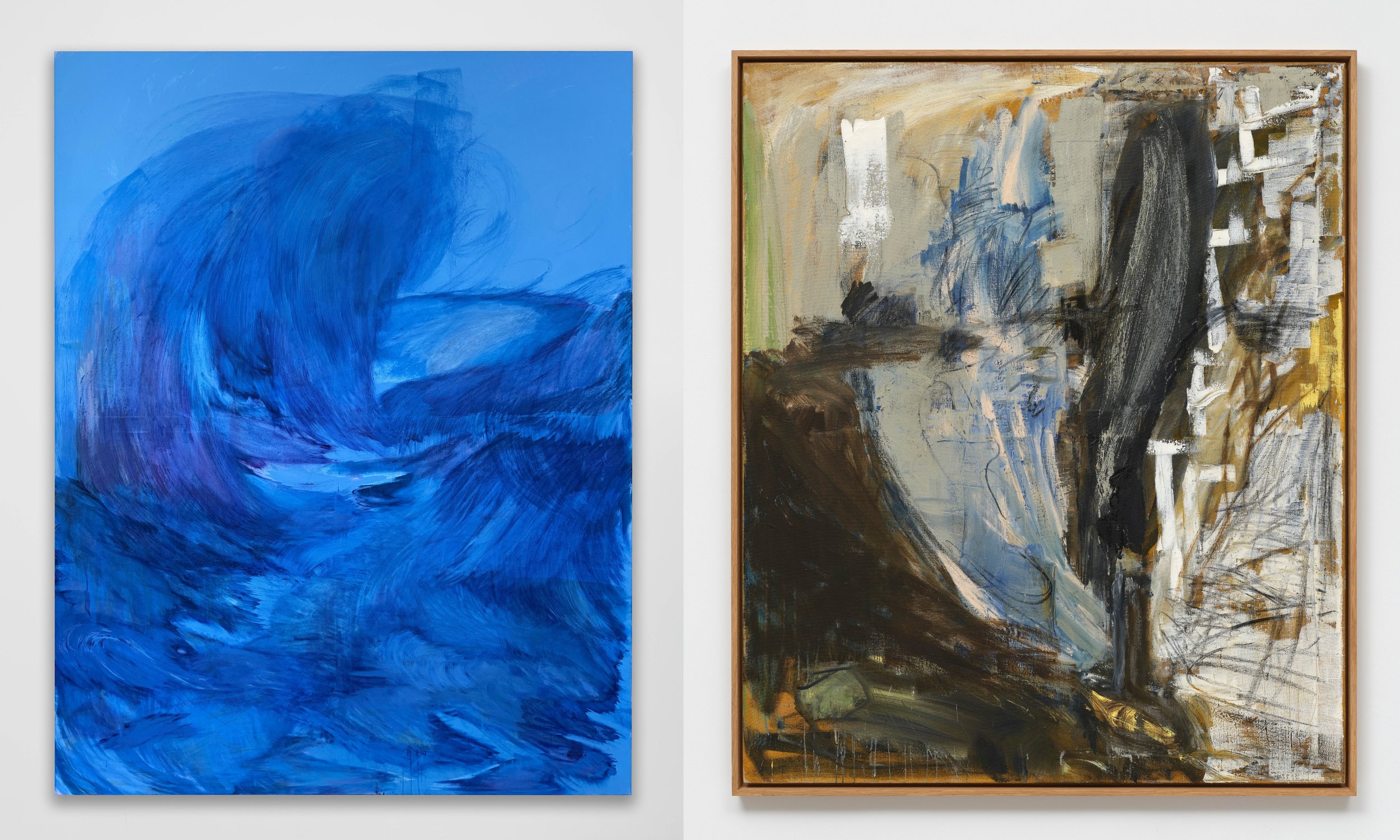
Lardy’s practice orbits disappearing landscapes, climatic instability, and Sublime traces. Her methodology is propelled into an anthropocentric territory, one inflected by Romantic ideals of the outdoors. In her newest paintings, glaciers and the experience of being subsumed by nature become vehicles for considering the impending threat of environmental collapse. Her largest composition is dominated by blue evocations of water, with residues of a pink ground layer serving as a warm undercurrent. Elsewhere, silver paintings use aluminum pigment to translate rock formations into shimmering abstractions.
Lardy’s diffuse fields find a denser counterpart in Per Kirkeby’s Radames, a tectonic abstraction from 1981. This earthbound work spells out the artist’s consistent fixation on geological stratification and inevitable breakdown. The Danish painter’s predilection for layered, sedimentary forms fuses with his investment in art history, as he repeatedly folds references to historical painting into his geological vocabulary.
Both Kirkeby and Sean Scully align on the building up of abstract forms. Rather than explicitly rendering rock, tree, or landscape, they cipher experience into the compositional process. In this exhibition, two aquatint prints by Scully foreground his structural instincts. Unlike Kirkeby’s tangled chroma, Scully organizes his compositions through more clarified methods. Horizontal and vertical lines quiver slightly, yet hold fast to a relative order. The artist refers to these bands as “directional,” their alternating fields of color defining a rhythm. Still, he’s willing to bury certain corridors, leaving minor vestiges of earlier brushtrokes to float into the viewer’s perception.
Coming from an alternatively photographic starting point, a work by Harold Ancart borrows the image of a French Polynisian atoll, subjects it to a methodical burn, and frames the result in bronze. The original picture sees a tourist-oriented stock image of the narrow coral reef flat cutting across an infinite ocean. With his intervention, the scene is disrupted by an imposing black mass foregrounded by a spattering of orange flecks. Where Ancart physically burns into the image, Lardy reverse-engineers landscapes through copper plates, oxidation, and thin layers of ink via an infrared ultraviolet printer. The resulting silver compositions are a specific effort to engage a process-based, materially sensitive painterly production.
Elsewhere, balletic ink marks dance across Julie Mehretu’s kinetic works on paper. These exist on their own terms–they are not preparatory drawings, but rather, autonomous demonstrations of what the line can do. Mehretu offers a subtle counterpoint to the other artists in the show, as she responds to geopolitical turbulence, diasporic movement, and man-made infrastructures. A connection to landscape, however, is reflected in her engagement with climate change, as seen through wildfires, unstable atmospheres, and other environmental conditions. In the works on view, though, a wide range of conceptual preoccupations are funneled into near-arabesques that suggest maps, weather systems, and migrational patterns without depicting anything directly. Her fluid linework finds a parallel with Lardy’s, both grounded in a shared use of graphite material.
Across the exhibition, natural synchronicities between these artists become apparent with their treatment of natural phenomena. Where Lardy and Kirkeby mine geological processes for their formal possibilities, Ancart converts landscape into an object of physical intervention, Mehretu translates environmental and geopolitical forces into kinetic lines, and Scully builds landscapes through ordered bands of color. Across these various approaches, a shared Romantic impulse emerges: the artists approach nature as a vehicle for articulating its vastness and volatility, sublimity and abstraction.
–– Reilly Davidson
___
Harold Ancart (b. 1980, Brussels) lives and works in New York. Ancart has presented solo exhibitions at the Menil Collection, Centre Pompidou-Metz, and the Musée d’Art Moderne de Paris. His work is held in the collections of the Solomon R. Guggenheim Museum, the Whitney Museum of American Art, Centre Pompidou, Fondation Beyeler, and the Louisiana Museum of Modern Art.
Per Kirkeby (1938–2018, Copenhagen) studied at the Eks-skolen (The Experimental Art School), Copenhagen (1962), and graduated from the University of Copenhagen with an MA in Arctic Geology (1964). He was Professor at the Academy of Art, Karlsruhe (1978–89) and at Die Städelschule, Frankfurt (1989–2000). His work is held in the collections of Centre Pompidou, Musée National d’Art Moderne, Paris; Louisiana Museum of Modern Art, Humlebæk; Metropolitan Museum of Art, New York; Museum of Modern Art, New York; Moderna Museet, Stockholm; Museum Ludwig, Cologne; Statens Museum for Kunst, Copenhagen; Tate Modern, London; among others.
Augusta Lardy Micheli (b. 1994, Geneva) is a painter based between Neuchâtel, Switzerland, and Paris, France. She studied Philosophy at King’s College London before completing a degree in Fine Arts at City & Guilds of London Art School. In 2021, she was awarded the Freelands Foundation Painting Prize. In 2025, she presented her first institutional solo exhibition at the Musée des Beaux-Arts Le Locle, Switzerland. Her work has been exhibited internationally, including in Madrid at Galería Belmonte, Vienna at VIN VIN, Mexico City at Karen Huber, Paris at Galerie DS, and in Switzerland with Galerie Lange + Pult.
Julie Mehretu (b. 1970, Addis Ababa, Ethiopia) lives and works in New York. Mehretu has been the subject of major solo exhibitions at the Los Angeles County Museum of Art, the Whitney Museum of American Art, the High Museum of Art, the Walker Art Center, and the Museo Nacional Centro de Arte Reina Sofía, among many others. Her work is held in the permanent collections of the Museum of Modern Art, the Whitney Museum of American Art, the Solomon R. Guggenheim Museum, Tate, Centre Pompidou, the Art Institute of Chicago, and numerous international institutions.
Sean Scully (b. 1945, Dublin) lives and works between New York and Europe. Scully has been the subject of major retrospectives at institutions including the Philadelphia Museum of Art, the Hirshhorn Museum and Sculpture Garden, and the Museum of Contemporary Art Zagreb. His work is held in the collections of the Museum of Modern Art, the Metropolitan Museum of Art, Tate, Centre Pompidou, and the Solomon R. Guggenheim Museum, among many others.